Beltane: A Rite for the Threshold
The hawthorn flowers on May morning whether you mark it or not. A plant-centred guide to Beltane — the fire festival, the nine sacred woods, the morning dew, and the old magic of the threshold between spring and summer.
The first of May arrives differently depending on where you are standing. In the city, it is a bank holiday, a morning that smells of cut grass and someone else's barbecue. In the garden, it is the moment the hawthorn blossom finally opens — thick, sweet, slightly rotten at the edge of the scent, white across every hedge. In the old calendar, it is Beltane: the fire festival, the hinge of the year, the night when the veil between worlds thinned and the cattle were driven between the flames.
What is consistent, across every version of this threshold, is fire and flowers. The two great purifications. One cleans by burning. The other by blooming.
What Beltane Was
The earliest surviving descriptions of Beltane come from Ireland — the great fire on the Hill of Uisneach, lit as a signal whose smoke could be seen across the island. Every hearth fire in Ireland was extinguished on the eve of May. New fire was kindled by friction from nine sacred woods. Then the new fire was brought into each house in turn, carried from the hill fire, and every hearth in the country was relit from the same source. For one night, all fire was the same fire.
The cattle were driven between two blazes — close enough to feel the heat on both flanks — to purify them before the summer pasturing. The people walked between the fires too, or leaped them. The smoke was the medicine. What passed through Beltane fire came through clean.
All fire was the same fire. For one night, the island breathed together.
This was not metaphor. It was practical theology — a technology of communal renewal applied at the moment the year turned from its cold half to its warm one. Imbolc had come in February, tentative, nursing the first green. Ostara had brought the equinox, the balance. But Beltane is the threshold in earnest: the cattle moving to high summer pasture, the crops committed to the soil, the warmth that might sustain or might fail, and the ritual fire lit to press the odds toward survival.
The magic was always practical. The plants always knew what they were doing.
The Nine Sacred Woods
The new fire was kindled from friction — a bow drill, a fire board — using wood from trees considered sacred. Different sources list different nine, but certain trees appear consistently: oak, ash, hawthorn, birch, rowan, willow, hazel, elder, and apple. The combination varies by tradition and by what grew locally. What is consistent is the plurality — not one sacred wood but nine, requiring nine different contributions, nine different relationships.
Oak brought the authority of the oldest standing presence in the grove. Birch brought the first-tree energy, the pioneer, the tree that colonised bare ground after the ice and does so still. Rowan brought protection — the tree planted beside byres and gates whose red berries and red thread were the primary wards of the Highland year. Hawthorn brought the living embodiment of the threshold itself, flowering exactly now, the plant whose English name for its blossom is May.
Ash brought the world-tree into the fire: Yggdrasil, the axis, the tree that holds up everything. Hazel brought wisdom and the divining capacity — the forked branch that finds hidden water. Willow brought the water margin, the bending-without-breaking, the grief that does not break the bender. Elder brought the permission of the threshold spirits — you did not cut elder without asking. Apple brought the otherworld: the Isle of Apples, Avalon, the harvest that waits on the far side of the threshold you are crossing.
Together, nine trees, nine qualities, one fire. The fire that relights everything.
The Hawthorn and the Prohibition
The hawthorn is the plant most completely identified with Beltane, and its relationship with the festival carries a paradox that is worth sitting with.
The blossom cannot be brought indoors before May Day. In Irish, Scottish, and English folk tradition alike, this prohibition is consistent and emphatic: to bring May blossom into the house before the first of May is to invite death in after it. The smell of the blossom — sweet, almond-adjacent, and at close range faintly of trimethylamine, the compound of both new life and corruption — was understood as the smell of the otherworld, which must be kept at the threshold until the threshold formally opens.
On May Day itself, the prohibition lifts. May blossom is gathered and brought in. It is woven into garlands and hung on doors and over lintels. The same blossom that was an omen the day before is now a welcome. The threshold has moved. The world has turned. What was dangerous on one side of midnight is celebratory on the other.
From the Conservatory
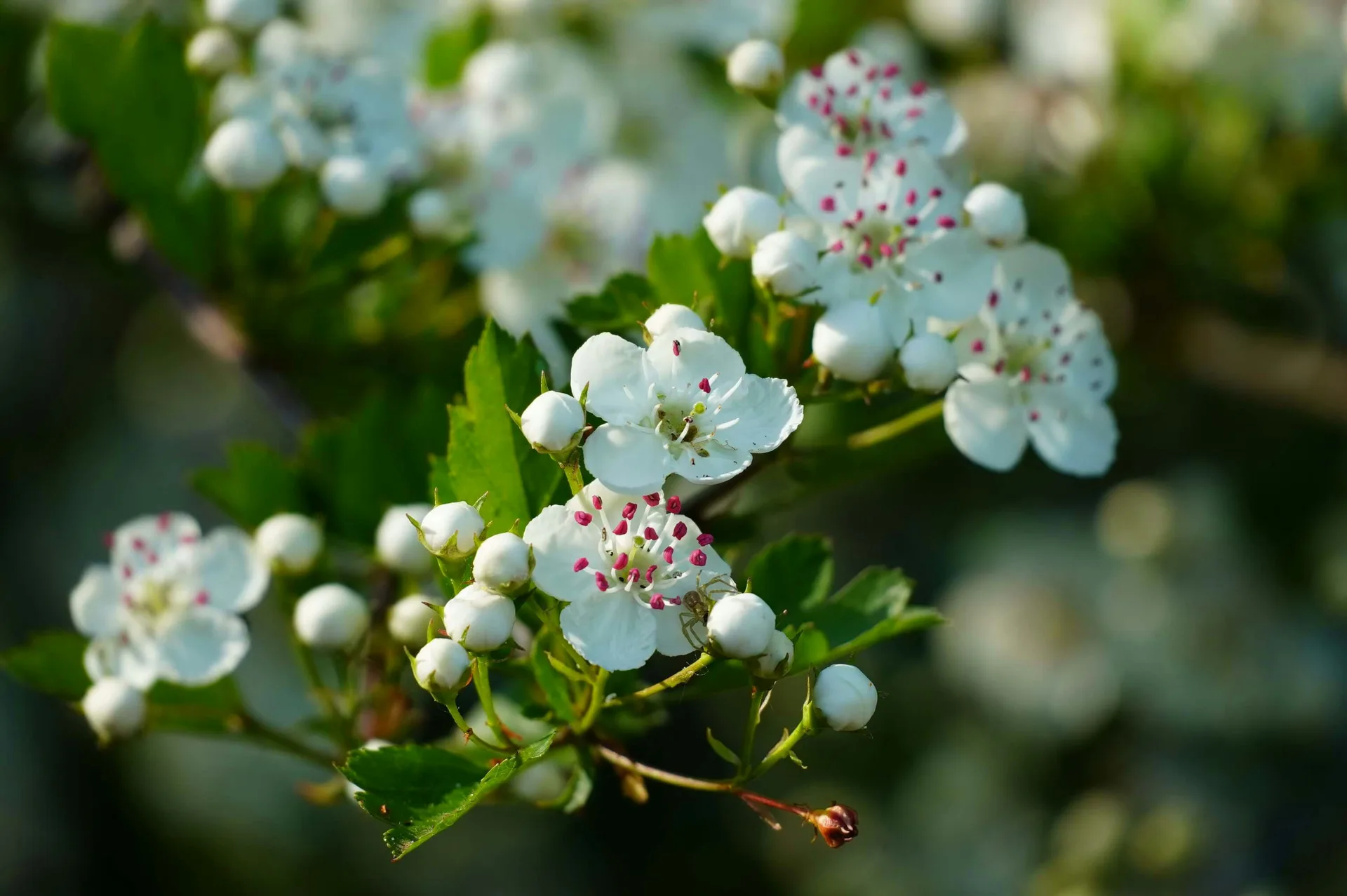
Hawthorn
Crataegus monogyna
You may rest beneath it. You may not cut it down.
The threshold tree. It flowers for Beltane and for no other reason the calendar requires. Everything about it — the thorns, the sweetness, the slight rot at the edge of the scent — belongs to the space between.
View entry in the Conservatory →The Morning Dew
May morning dew has been credited, in British folk tradition, with particular magical properties from at least the sixteenth century. Samuel Pepys records London ladies rising before dawn on May 1st to go to the fields and wash their faces in it. The dew of May morning, caught before sunrise, was said to clear the complexion, preserve youth, and carry good fortune through the year.
The rational explanation — dew is clean water, rich in nitrogen from the night air, gathered on plant surfaces at a time of significant biological activity — is less interesting than the timing. May morning is the threshold moment of the threshold festival. The dew that lies on the hawthorn blossom and the meadowsweet and the gorse and the young birch leaves at dawn on May 1st has, in some sense, been in contact with all of that plant life through its most active season. It carries the morning. It carries the year's turning.
Whether you wash your face in it or simply press your palms to the wet grass or gather it in a small bottle and keep it through the year: the practice is worth having. The ritual of going out before the world is fully awake to meet the threshold in the field is older than any explanation of why it works.
Yellow Flowers at the Door
A specific folk protection for Beltane Eve: yellow flowers at the threshold. Primroses, cowslips, gorse blossom, marsh marigold — yellow, the colour of Beltane fire rendered in petal form — laid on doorsteps, pressed into the hinges of doors, scattered on windowsills. The flowers were sometimes arranged in specific patterns, sometimes simply strewn, sometimes braided into ropes and hung from the lintel.
The yellow of gorse in May is particular: thick, almost aggressive, carrying a vanilla-coconut scent that is entirely at odds with the plant's ferocious spines and its reputation as a fire hazard. Gorse blossom at Beltane was a declaration — the year has turned, the cold is losing, here is all the yellow I have available, placed where what crosses the threshold must pass through it.
In gardens where cowslips still grow, and on headlands where gorse lights up, gather a handful. Place them where things enter your house. This is not complicated magic. It is the magic of threshold-marking — of making the invisible line visible, of saying: this side and that side are not the same, and I know which side I want to be on.
A Plant-Centred Beltane Practice
The full Beltane of the Irish high kings — the hill fire, the extinguished hearths, the cattle driven through — is not recoverable and should not be performed as if it were. What is recoverable is the structure: purification, threshold-marking, the welcoming of the new fire, the acknowledgement that the year has turned.
On May Eve (April 30th):
Go outside after dark and find something living — a hawthorn hedge, a gorse bush in flower, the damp lawn under elder. Stand in it long enough to feel the temperature of the night and the smell of the growing things. This is the threshold vigil. You do not need to perform it. You only need to be present for it.
Light a candle from which you will relight your house's other lights — a small enactment of the new fire. Let the old lights go out. Relight them from the one flame.
Lay yellow flowers or flowering branches at your door before you sleep.
On May Morning:
Go out before sunrise if you can. Wet your hands in the dew on whatever grows near you. If you have vervain or rowan or hawthorn near your door, touch them before you come inside — they are the guardians of your threshold and Beltane is the moment to acknowledge them as such.
Bring May blossom in, if you have it. The prohibition has lifted. The fire is new.
The Plants That Preside
Different plants carry different aspects of Beltane's character, and tending them now — even simply noticing them — is its own form of participation in the festival.
Hawthorn — the threshold itself. If you have one, stand under it on May morning when it is in full flower. The smell at close quarters, at that moment, is unlike any other experience the botanical year offers.
Birch — new beginning, the pioneer. Its catkins have been out since February. By May it is in full leaf, young and green in a way it will not be again until next spring. Good wood to burn in a Beltane fire if you make one.
Gorse — yellow threshold-marker. Its flowers are edible and can be used to make a wine that tastes of vanilla and the smell of warm heath. One of the few plants that is genuinely warm in scent as well as colour.
Rowan — the protective presence. If your threshold lacks one, Beltane is the traditional time to plant it. Red berries and red thread — a sprig of rowan bound with red thread placed above the door — was the primary Beltane protection across the Highlands and Islands.
Vervain — gathered at Beltane before sunrise, while neither sun nor moon was on it, according to the old instructions. It was gathered barefoot, the earth touched before the plant, in a ceremony of asking. Even the simplified version of this — going out to find vervain and cutting it with some degree of acknowledgement — has its own quality.
Meadowsweet — not yet in flower at Beltane, but the leaves are up, and the scent of them — crushed between the fingers — is the smell of summer arriving. One of the three druidic sacred herbs. One of the three flowers used to make Blodeuwedd, the woman of flowers. The smell of the threshold between spring and summer.',
A Final Thought
The old Beltane fire is not available to us in its original form. The hill of Uisneach does not send signal fires across Ireland on the first of May, and the cattle do not walk through flame at dawn. But the hawthorn still flowers on the first of May, within a week or two, as reliably as it has for every Beltane in recorded history. The dew still lies on the grass before sunrise. The gorse is still yellow. The year still turns.
Ritual is the art of noticing the turn and choosing to stand in it rather than through it. The plants do not require ceremony from us. They will flower and fruit and die and return regardless. The ceremony is for us — to mark the threshold so that we cross it consciously rather than drifting past it with our eyes down.
Notice where you are in the year. Go outside before the world starts. Touch the wet grass.
The threshold is always underfoot.